


When I was about seven or eight, I had an out-of-body experience and found myself in a hospital room in São Paulo. A relative of mine was recovering there from surgery. I didn’t know he was ill, I had never been to São Paulo or inside a hospital, and we had no TV at home. Only later did I learn that what I had seen was real, down to the details of the room.
To me, that was just another experience. What frightened me were other moments: hearing someone speak to me, turning around, and finding nobody there. I wasn’t afraid of the voice. I was afraid of not understanding, and of having no words to explain it. For a long time, I told no one.
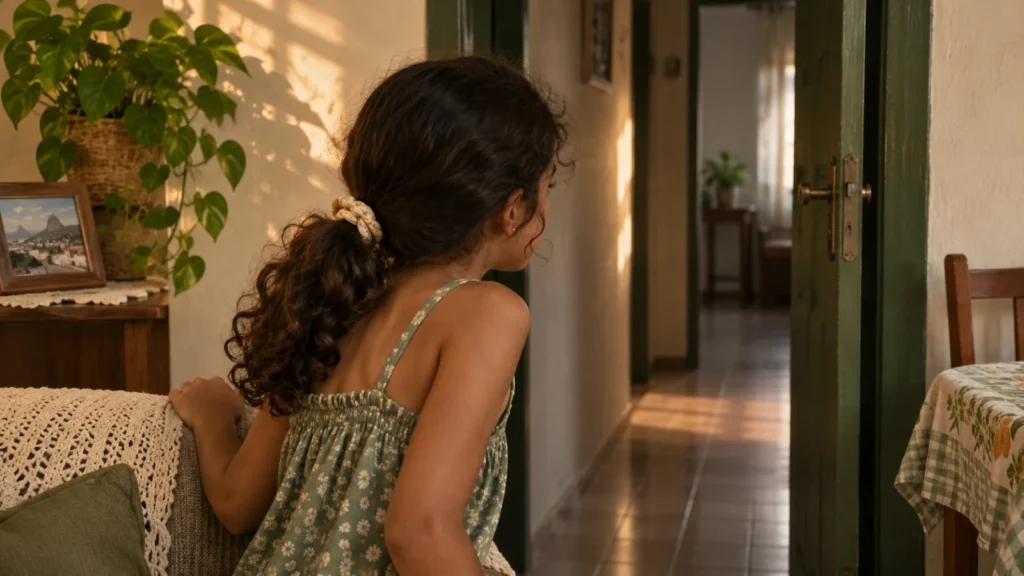
Many children live something similar. They sense, see or hear what others don’t, and they face it alone, caught between fear and confusion. After nearly 30 years of teaching people how to perceive and understand their energy, I kept meeting parents and teachers who didn’t know how to help these children. So, I decided to study them.
How I studied it
This was an exploratory study using mixed methods. I listened to each story in depth, without preconceived ideas, then looked for patterns across them.
- 36 participants. I conducted 31 in-depth interviews, some lasting two and a half hours, and collected five more accounts through written questionnaires and message exchanges.
- Ages 2½ to 57 at the time we spoke. With the youngest, a little girl, I observed her while her mother described what was happening.
- Childhood only. I counted experiences up to age 14, so the data reflects childhood rather than adolescence.
- Diverse backgrounds. Participants came from 13 countries (most from Brazil), lived in 8 (most in the United States), and grew up in six different religious traditions.
- Many from outside my field. 42% were neither students nor members of the International Academy of Consciousness (IAC). Some didn’t even know the vocabulary we use to describe these experiences.
- No drugs. None of those I could ask reported using drugs as children.
I let people tell their stories in their own words and avoided leading questions. Whenever an account could have been a dream, imagination, or something read in a book, I left it out, even after hours of interview.
I also created scales to measure how clear a perception was and how much fear it caused. “I saw something” and “I was afraid” can mean very different things, and the degree matters.
Imagination, illness, or a gift?
When a child says they see, hear or feel someone who isn’t there, adults usually reach for one of three explanations.
- It’s imagination. Children have rich fantasy lives, and sometimes that is exactly what’s going on. Imagination is natural and healthy, and we need to recognize it.
- It’s a disorder. Some cases do have a medical or psychological cause: a psychiatric condition, a sleep disorder, a biochemical imbalance, or a trauma surfacing through these experiences. Those children need proper care.
- The child is special. People who accept that perception can go beyond the physical senses often see these children as gifted or more advanced.
I agree with the first two, case by case. The third is the one I disagree with, even though I study these phenomena. When a child truly perceives something beyond the physical, I don’t see it as a sign of being special, nor of being ill. It is a natural condition, and it deserves to be treated that way.
The real challenge is telling these situations apart. Conventional medicine classifies many of the experiences I studied as parasomnias, events around sleep: sensing a presence, feeling touched, floating, falling, or seeing one’s own body.
These experiences are common and well documented. Sleep paralysis has been found in up to 62% of some populations, and in a Canadian study of 6,730 people, between 78% and 98% felt fear during episodes. In Japan, 43% of college students surveyed linked it to spirits or the supernatural. One German study found night terrors in 18% of children aged 6 to 11.
The data is solid. What I question is the interpretation, which assumes from the start that nothing beyond the brain could be involved. Popular science articles often conclude that people who are sure they had a paranormal experience most likely had sleep paralysis, and the inquiry stops there.
Mainstream research also urges caution. Psychiatrists who study childhood-onset schizophrenia note that hallucinations are not uncommon in healthy children, and that a diagnosis should not be based on them alone. A systematic review of studies in developed countries also found signs that mental disorders in children are sometimes overdiagnosed or misdiagnosed. And when researchers at the U.S. National Institute of Mental Health re-evaluated 71 children referred with suspected childhood-onset schizophrenia, 73% received a different diagnosis. (See the references at the end.)
What the children experienced
The experiences usually began early. Most participants placed the first ones around age 5, and several remembered them from age 2.
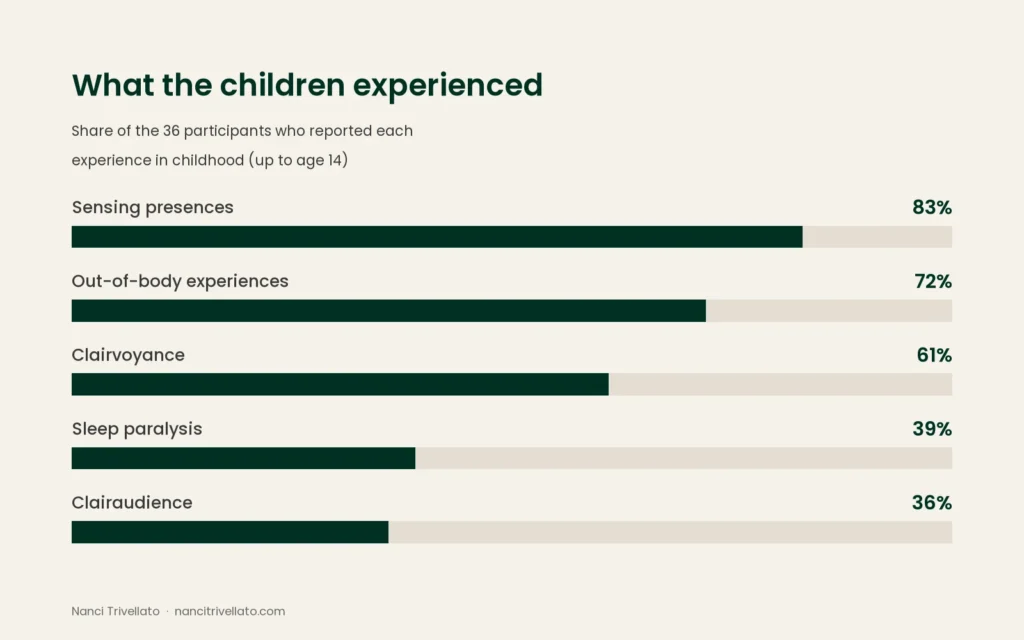
- Non-physical presences were the most common experience: 83% sensed presences or “intangible people” around them, most of them both day and night.
- Out-of-body experiences were far more common than I expected: 72% described them, often without knowing the term. Children spoke about them as naturally as going out to play.
- Clairvoyance (seeing beyond the physical) appeared in 61%, clairaudience (hearing beyond the physical) in 36%, and 28% had both.
- Sleep paralysis before 14 was reported by 39%. Several others had it only after 14, which suggests it becomes more frequent from adolescence on.
- The vibrational state, an intense vibration of one’s energy that many adults learn to produce, was rare: only three cases before 14.
- Other experiences included precognition or strong intuition (nine people), three cases suggestive of past-life memories, three spontaneous expansions of consciousness, and one near-death experience.
Two patterns stood out. Introverts, who made up 61% of participants, more often perceived presences (86% vs 56% of extroverts) and had out-of-body experiences (72% vs 55%). And while 72% of participants were women, the men more often reported out-of-body experiences (80% vs 65%), and the women more often perceived presences (84% vs 50%). These are suggestive patterns in a small sample, not conclusions, and they deserve further study.
A woman in the corner of the room
One case shows why “hallucination” doesn’t always fit. A little girl of about two, cheerful, sociable and very talkative, would sometimes wake at night in terror. She would point to a corner of her bedroom and describe a woman standing there, down to her clothes.
Her parents would take her to the living room to play, and the woman was gone. Back in the bedroom, the girl described the same woman again. This happened about four times. Her siblings never behaved this way.
Her mother, a medical doctor, brought her to me because she didn’t know how to help. Which raises a question: how can a hallucination be so stable, and disappear just by changing rooms?
Where the fear comes from
My study was not about fear, but fear kept showing up in the data, and it followed clear patterns.
- Night made it worse. During the day, most children felt little or no fear of the presences they sensed. At night, most felt strong, sometimes paralyzing fear.
- Sensing without seeing was scarier than seeing. The most frightening experiences were those in which the child felt something but couldn’t see what was going on.
- What was seen mattered more than how clearly. With clairvoyance, fear depended less on the clarity of the perception than on where it happened and who or what was seen.
- Out-of-body experiences were rarely frightening. 69% felt no fear at all, and a few felt surprise or confusion. No one described strong fear of being out of the body.
- Some places mattered. Several people were afraid in one room of the house and fine in the room next door, so they would move to sleep elsewhere.
- Having no words made it lonelier. Children rarely have names for what they perceive, which makes it harder to understand, remember and share.
One participant described it like this:
“I was afraid from 4 to 12. I knew there were [intangible] people around. I could feel it. Sometimes I would hear them, sometimes I would see, and sometimes I would feel them touching me. […] When I told my mother, I saw the fear in her face – she was paralyzed. […] So, I thought there was something wrong with me, with my mind. Then I did not say it again.”
Children found their own ways to cope. The most common was curling up completely under the covers, even in summer, leaving only a small tunnel to breathe. Others turned on the lights, sought refuge in their parents’ room, froze, prayed, or would only fall asleep with their back against the wall. Only one reported crying, so a child who doesn’t cry is not necessarily a child who isn’t afraid.
The parents’ reaction matters most
For me, this was the most important finding: the parents’ reaction can be harder on a child than the experience itself. When a child knows they were awake and an adult says “it was just a dream,” the child ends up confused twice.
44% of participants never spoke to their parents about their experiences. Of the 19 who asked for help, 14 felt it didn’t help at all, and one felt it helped very little. The four who said it truly helped had parents who had studied these subjects themselves, and could talk about them naturally, without mystery or alarm.
Extreme fear is neither natural nor permanent. In most of the cases I studied, it came from a lack of information, or from having been taught to be afraid. When a child does perceive something unpleasant, some fear is natural. What helps is learning how to deal with it.
Who these children became
These children grew up to live full, ordinary lives. Among the 29 adults are economists (two of them in senior positions at national treasury departments), business executives and entrepreneurs, a university lecturer, musicians, an illustrator and a photographer, engineers and architects, two medical doctors, a dentist and a medical student, psychologists and a psychotherapist, a researcher, a teacher, a ballet dancer and a coach.
For most, the experiences didn’t go away: 28 of the 29 adults (97%) still have them. What changed was how they feel about them. Two out of three (66%) see their childhood experiences as positive in their lives, seven see them as neutral or are unsure, and none described them as harmful. Only two are still afraid.
A medical doctor in her thirties, who lived in fear for about ten years in one particular house, told me:
“It was a pity no one told me what it was, or taught me to use my energy. Nowadays that I understand about energy I have all of those experiences, including OBEs, but I don’t have fear.”
How parents can help
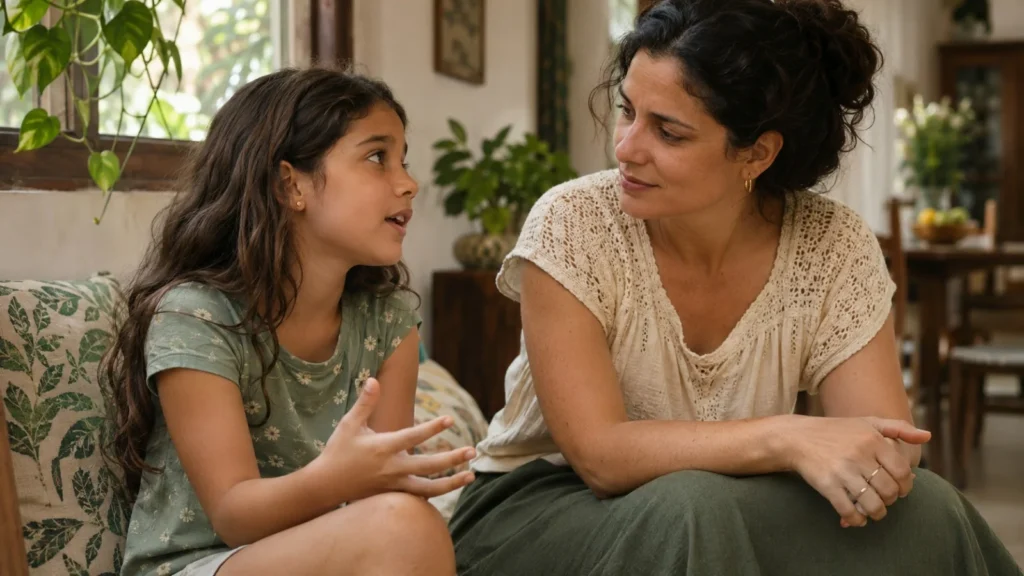
- Stay calm. Children read your face before your words. If you look frightened, they may conclude that something is wrong with them.
- Listen before you explain. Ask open questions: “What happened? Where were you? What did you notice? How did you feel?” Avoid questions that suggest an answer, like “Did you see a ghost?” Leading questions can push a child to invent details to please you, or to shut down.
- Don’t dismiss it, and don’t glorify it. Saying “it’s just your imagination” to a child who knows they were awake adds confusion. Calling them special or gifted adds pressure. Never push a child to have these experiences, and never tell them it’s wrong to have them. We don’t tell children it’s wrong to dream.
- Explain in simple words. You might say that, just as we see light and hear sounds, we can also pick up energy and information around us: from people, from places, and sometimes from consciousnesses who are not physical. Use your child’s own words. Children often prefer to talk about “my mind” rather than “my energy.”
- Watch for signs. Fear that grows at night, trouble falling asleep, waking up frightened, insisting on the lights, sleeping completely covered, asking to sleep in your room, or avoiding one particular room can all be clues.
- Pay attention to the place. If the fear is tied to one room, take note, and consider letting your child sleep elsewhere while you look into it. My article on the energy of your bedroom offers ways to care for that space.
- Keep every explanation on the table. If sleep, mood, school or daily life are affected, talk to your pediatrician or a child psychologist, and share everything your child described. Look for professionals who will listen to your child before reaching conclusions.
When participants learned I was writing a book for parents, many asked me to pass on a message. Two of them, a 13-year-old and a 38-year-old, had suffered because their experiences were treated as a psychiatric case. The 13-year-old wrote: “Please tell parents to see this as a natural thing. This will relieve the weight on the child. Otherwise, the child will try to block what they actually feel.”
The 38-year-old was more direct: “Don’t medicate your child. Please listen to them first.” This is not an argument against medical care, which some children truly need. It is a plea about order: listen first, so that whoever helps your child starts from the whole picture.
If this was you
If you recognized yourself in these pages, you are far from alone. Most people in this study grew into balanced adults who still have these experiences, now without the fear.
Understanding is what changed things for them. Giving names to what you perceived, learning how energy works and how to manage your own, turns confusion into knowledge. It also helps you tell a real perception apart from a dream or a passing impression.
If you’d like a starting point, my articles on kundalini and sleep paralysis and on psychic phenomena associated with out-of-body experiences explore some of the experiences described here.
Watch the presentation
I have presented this research to colleagues in consciousness studies, with more data and cases than fit in an article. You can watch one of these presentations on YouTube.
This was the first, exploratory phase. Next, I plan to compare these results with a control group, survey the general population, and look more closely at specific experiences. I am also writing an accessible book for parents, so that no child has to face these experiences alone.
To hear when it’s ready, join my Priority Access list. If you’d like to look at your own experiences, or your child’s—in a private conversation—, you can learn about my Consciousness Compass sessions.
My heartfelt thanks to every participant who trusted me with such intimate memories, and to the International Academy of Consciousness (IAC) for supporting this research.
References
- Cheyne, J. A. (2002). Situational factors affecting sleep paralysis and associated hallucinations: position and timing effects. Journal of Sleep Research, 11(2).
- Dahlitz, M., & Parkes, J. D. (1993). Sleep paralysis. The Lancet, 341(8842).
- Driver, D. I., Gogtay, N., & Rapoport, J. L. (2013). Childhood onset schizophrenia and early onset schizophrenia spectrum disorders. Child and Adolescent Psychiatric Clinics of North America, 22(4), 539–555.
- Fukuda, K., Miyasita, A., Inugami, M., & Ishihara, K. (1987). High prevalence of isolated sleep paralysis: Kanashibari phenomenon in Japan. Sleep, 10, 279–286.
- McKenna, K., Gordon, C. T., Lenane, M., Kaysen, D., Fahey, K., & Rapoport, J. L. (1994). Looking for childhood-onset schizophrenia: the first 71 cases screened. Journal of the American Academy of Child and Adolescent Psychiatry, 33(5), 636–644.
- Merten, E. C., Cwik, J. C., Margraf, J., & Schneider, S. (2017). Overdiagnosis of mental disorders in children and adolescents (in developed countries). Child and Adolescent Psychiatry and Mental Health, 11, 5.
- Schredl, M., et al. (2001). Night terrors in children: prevalence and influencing factors. Sleep and Hypnosis.


