After an out-of-body experience, how can you tell whether you remember what you perceived or how you interpreted it? This question matters to anyone exploring astral projection—and it was central to OBE research that Wagner Alegretti and I conducted.
Imagine perceiving a dark center surrounded by yellow during an OBE. Once your attention returns to your physical body, you remember a sunflower. But what if the image you were trying to observe was actually a black square with a yellow border?
Did you perceive some of its features and give them a familiar meaning? Did the impression change as you remembered it? Or was the resemblance coincidental?
Understanding the relationship between perception, interpretation, and recollection can help you examine your own experiences with greater clarity.
In our experiments, we explored these questions using hidden visual targets, a controlled protocol, and independent auditors.
Our interest went beyond whether participants could see an unknown image during an OBE. We wanted to understand which details they perceived and how they made sense of them.
Having an experience and understanding it accurately are related, but they are not identical.

Why OBE perception and memory matter
An out-of-body experience, or OBE, is an experience in which you perceive yourself as located outside your physical body. It is also commonly called astral projection.
Our study approached the phenomenon through a multidimensional model of consciousness: the working hypothesis that consciousness can exist and function beyond the physical body.
Within that framework, we asked: How does someone perceive, interpret, and remember information observed during an OBE?
Our aim was to better understand these processes to offer insights for people exploring OBEs. We investigated how impressions perceived outside the body might become accessible to the physical brain—and whether their interpretation or recollection might change in the process.
The paper linked below reports on our first two experiments, conducted in 2001 and published in 2002. The questions they raised remain relevant to exploring your own experiences.
The research behind the sunflower example
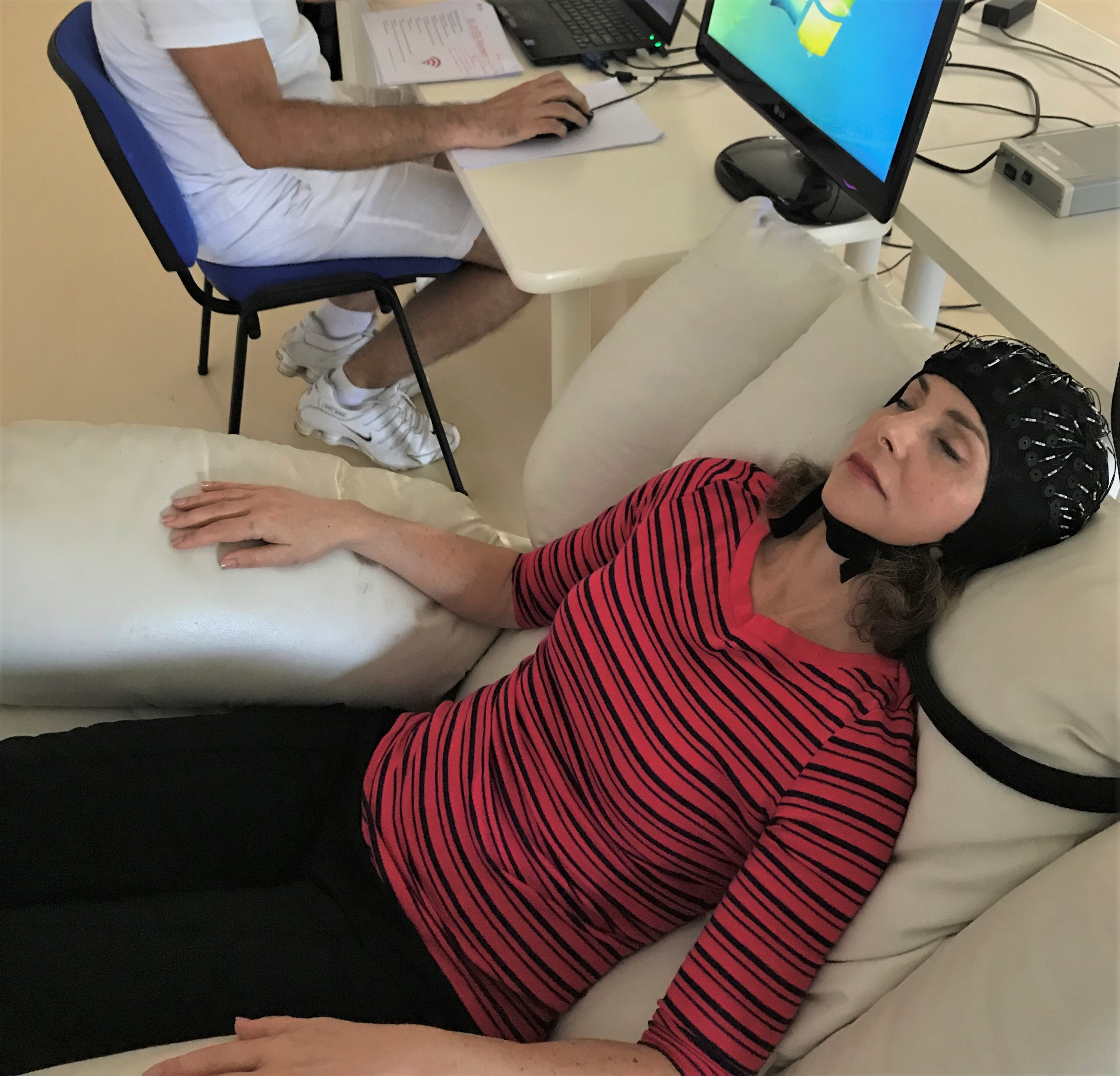
The experiments took place during OBE workshops in Évora, Portugal, and Segovia, Spain, with a total of 105 participants. Their task was to attempt an OBE and observe an unknown image displayed in a separate room. At least five further series of tests followed; these are not covered in the paper.
The image was selected by a computer after the researcher and independent auditor had left the target room. The room was locked and monitored, and participants submitted written reports before discussing their experiences or learning what the target was.
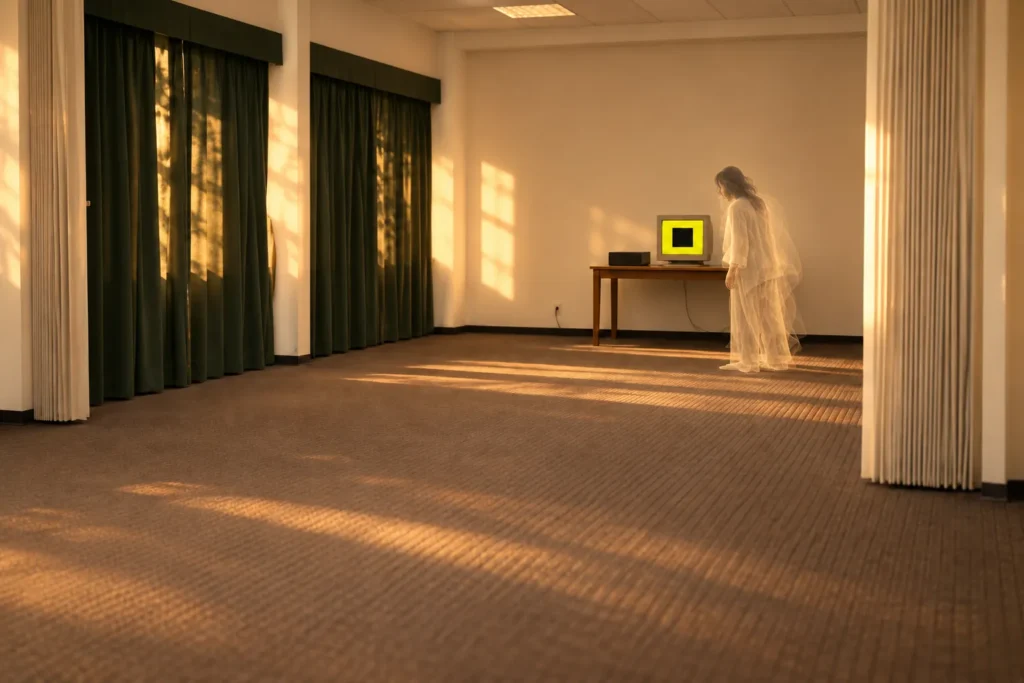
The sunflower example comes from these experiments. Two participants reported a sunflower when the target was a black square surrounded by a yellow band. Their descriptions resembled the arrangement of a dark center with yellow around it, but not its square shape.

This raised the possibility that a partial impression could have been interpreted as a familiar object. It illustrates the distinction between perceiving visual features and identifying what they represent.
Before the sessions, participants had not seen the image bank and did not know what kinds of images it contained. As far as they knew, the target could have been a letter, the sun, a city, an eye, a cell, or anything else that could appear on a computer screen. Given that range of possibilities, I consider these correspondences statistically remarkable.
What did you see—and what do you remember?
When examining an OBE, it can help to separate three questions:
- Perception: What did you experience seeing?
- Interpretation: What did you think it represented?
- Memory: What can you recall and describe afterward?
Suppose you wake up remembering a narrow red shape from an experience in which you felt conscious outside your body.
Do you remember the shape itself, its color, or an object you associated with it, such as a thermometer? If you identify it as a thermometer, does that label become more prominent in your memory than the visual details?
Within a multidimensional model of consciousness, this raises another question: how might an impression perceived through the astral body become a memory you can access through your physical brain?
The experiments provided observations that helped us refine these questions for further research.
How to record an OBE without losing important details
One practical implication is the importance of preserving the details of an experience before settling on an explanation.
For example, seeing “a dark center with yellow around it” is different from “a sunflower.” The first describes visual features. The second identifies an object.
If you keep an OBE journal, these practices may help:
- Record the experience soon afterward, including details that feel incomplete.
- Sketch shapes, colors, and positions when words seem insufficient.
- Distinguish what you experienced from what you think it means.
- Preserve uncertainty rather than filling gaps in the account.
- If you are attempting to observe a hidden target, record your impressions before checking it. Compare differences as carefully as similarities.
These practices can make your records more useful for reflection and comparison, while helping you distinguish observation from interpretation.
For me, exploring our multidimensional nature includes developing discernment. Preserving healthy uncertainty can be part of understanding an experience and its complexity more accurately.
OBE or remote viewing: why the distinction matters
Another question in the study was whether a description of the hidden target necessarily came from an OBE.
Remote viewing involves attempting to perceive a distant or hidden target without ordinary sensory access, while remaining aware of yourself as being inside your body. During an OBE, you experience yourself as located outside your physical body.
Within our research model, participants could perceive the target either by traveling to its location during an OBE or through remote viewing while remaining inside the body. An accurate description alone would therefore not distinguish between these experiences or establish how the information was obtained.
To help assess the nature of each experience, we included specific questions about participants’ perceived experience. Their answers provided useful context, although some reports could not be confidently classified as OBE or remote viewing.
Read the full OBE research paper
This article draws on the paper I coauthored with Wagner Alegretti, Quantitative and Qualitative Analysis of Experimental Research Project into Out-of-Body Experience (2002).
The full paper presents the experimental procedures, examples of participant reports, our interpretations, and proposals for improving the methodology. It also discusses unexpected reports interpreted as possible precognition.
For comprehensive training in out-of-body experiences, I recommend IAC’s award-winning Consciousness Development Program (CDP).